Twenty-one acres in the middle of town, roughly bounded by Graham Street, Martin Luther King Drive, McCaskill Street and Florence Street, hold forty-nine contributing buildings put up between about 1884 and 1948. The district joined the National Register on 12 February 1999. These are the houses we can name so far. The list is incomplete, and we say so plainly at the bottom of this page.
 No photograph yet
We have not found a picture of this house we can publish. If you have one, we will credit you.
The oldest surviving frame building in Maxton. It began as the law office of Gilbert Patterson and was moved to its present site on Graham Street in 1972. It now houses the Maxton Historical Society museum — so the building that has outlasted every other frame structure in town is also the building where the town keeps its records.
No photograph yetWe have not found a picture of this house we can publish. If you have one, we will credit you.
Built for Major A. J. “Sandy” McKinnon, who made his money in cotton and truck farming. A large two-storey frame house with intricately carved trim on the frieze and the portico. It belongs to the period when Maxton's businessmen built large houses close to the middle of town rather than out on the land they farmed.
No photograph yetWe have not found a picture of this house we can publish. If you have one, we will credit you.
Grander still than the McKinnon house, and built three years later by Robert Lee McLeod, a successful lumberman. Also two storeys and Neoclassical Revival. The two houses together mark how much money moved through Maxton in the decade the Patterson Building went up.
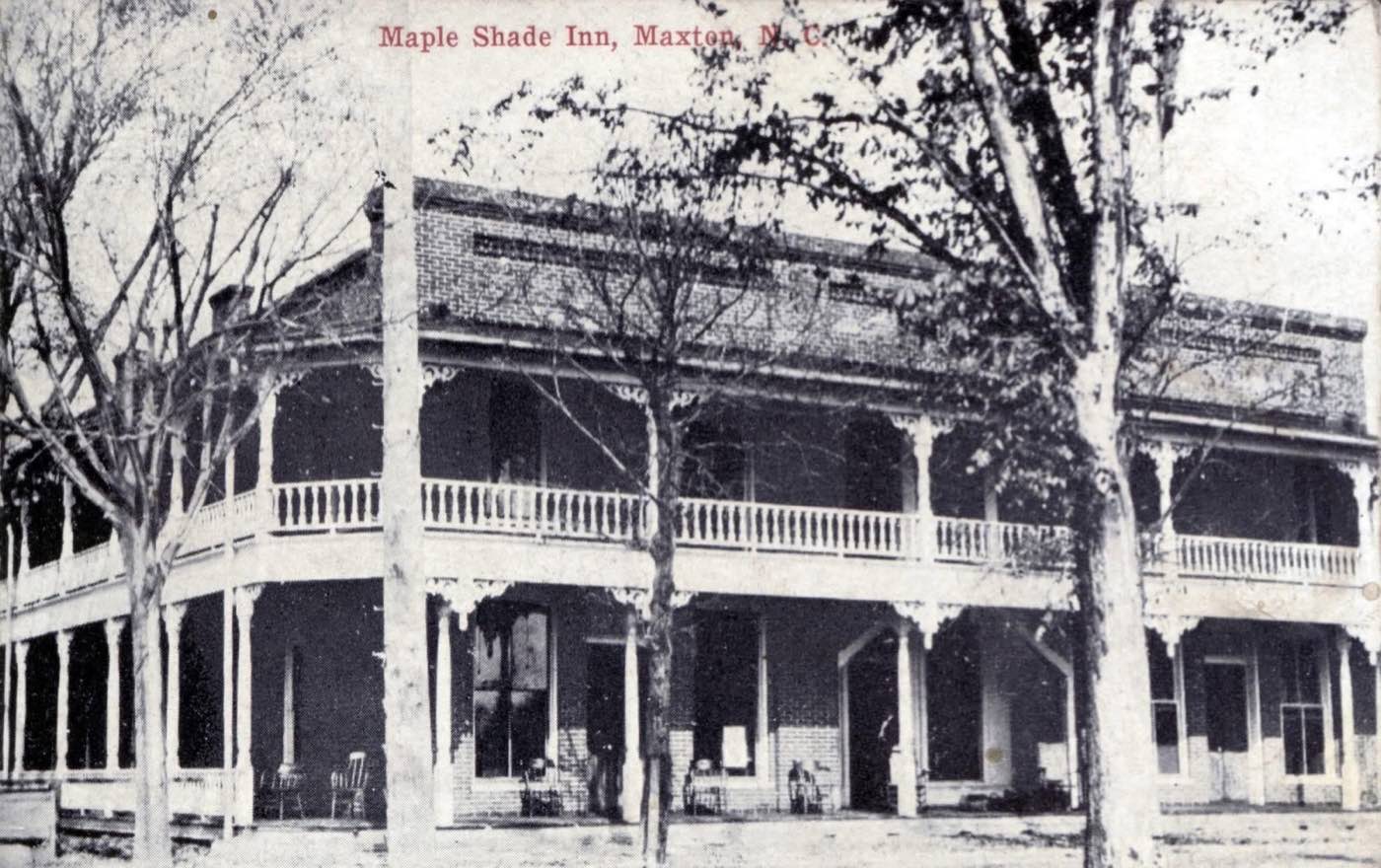
This one is a hotel, not a family home — and it is gone. A brick hotel called the McCaskill House opened in November 1889, was later renamed the Maple Shade Hotel, and was demolished in the 1950s. It is the building on the postcard, with its two tiers of verandah and sawn woodwork.
The name causes real confusion, so it is worth being plain about it: the demolished hotel and the McCaskill family residence are two different buildings. This page previously ran them together and flagged the record as contradictory. It is not contradictory — there were simply two.
Source: the National Register of Historic Places district description — “A brick hotel, the McCaskill House, opened in November of 1889 (later the Maple Shade Hotel; demolished in the 1950s).”
No photograph yetWe have not found a picture of this house we can publish. If you have one, we will credit you.
Separate from the hotel above, and still standing: a house built by John C. McCaskill for his son, as a wedding gift. John C. McCaskill was among the men who moved into Maxton by 1869, drawn by the railroad, the land and the timber, and he was running a business in the town by 1875. The avenue carries the family name.
The wedding-gift account comes from the present owner rather than from a published source, and we have not yet found it in print. If the Maxton Historical Society holds the deed history, this entry gets finished properly.
No photograph yetWe have not found a picture of this house we can publish. If you have one, we will credit you.
When the original Maple Shade Inn burned, Mrs. Sue Kelly McRae converted part of this large house and an outbuilding into a hotel to replace it. That makes two buildings in Maxton to have carried the Maple Shade name, which is worth knowing before anyone matches an old postcard to an address.
Source: the “Remembering Robeson County’s History” community group. Contributed local history, not yet checked against the Historical Society’s records.
Details comingWe know this one is in the district. We do not yet have the name, date or a photograph.
A further contributing property on Central Street, identified by the Commission. Name, date and photograph still to come — if this is your house, or you know whose it was, we would like to write it up properly.
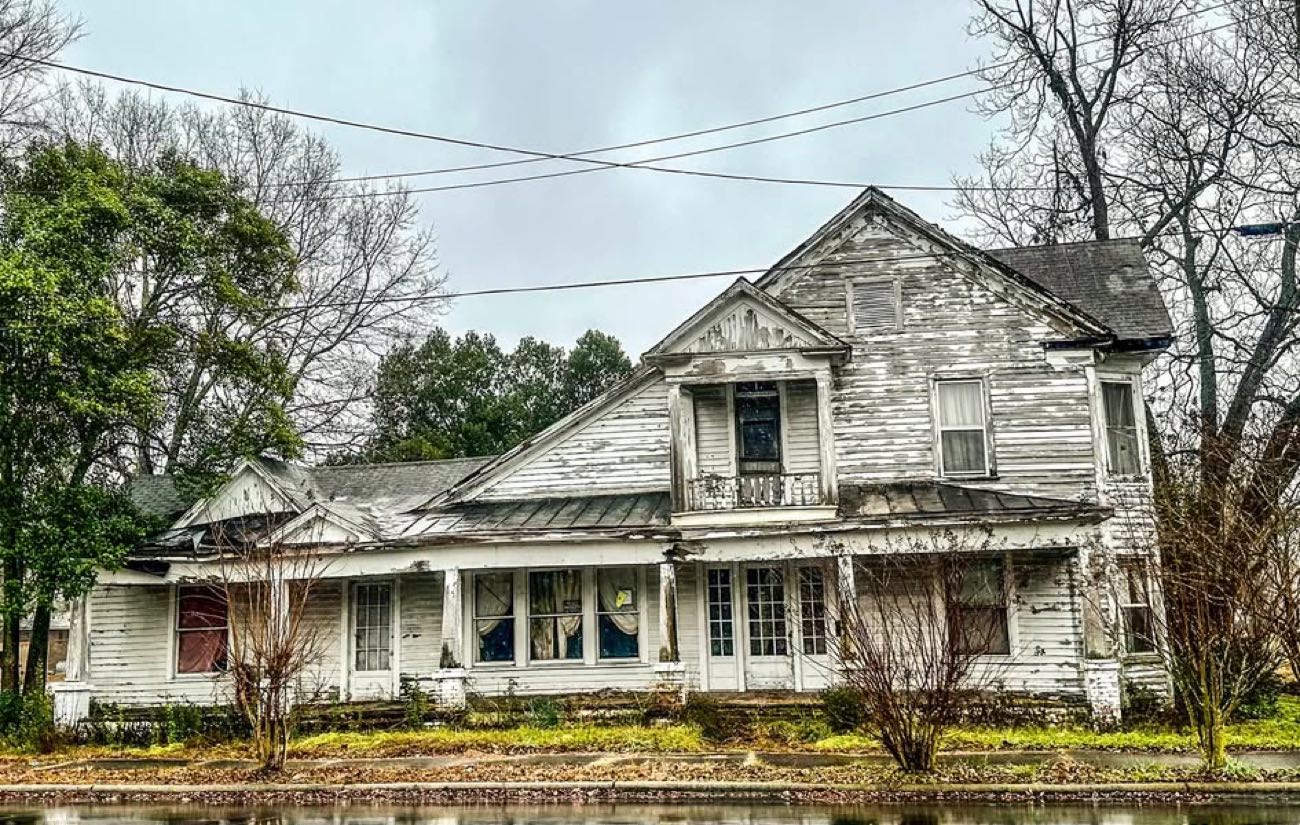
A two-storey frame house with a deep porch, decorative gable trim and a small upper balcony — clearly one of the town's older dwellings, and clearly in trouble. The post that carried it did not say which house it is.
If you recognise it, tell us. A street name is enough to start with.
Identify ItThe earliest surviving buildings go up close to the railroad crossing that made the town. The Gilbert Patterson Law Office, about 1885, is the last frame structure of that generation still standing.
Cotton, lumber and the two rail lines put money in Maxton, and the men who made it built large houses within walking distance of their offices rather than out on the land. The McKinnon and McLeod houses both date from this decade.
Residential building pushes north from where Graham Street meets McCaskill Avenue. From this decade a separate African American neighbourhood develops along East Wilmington Street and the streets around it — the segregated pattern that shaped where families in Maxton have lived ever since.
The McCaskill House, by then the Maple Shade Hotel, is demolished. It is the loss that makes the surviving postcards worth keeping.
Housed in the Gilbert Patterson Law Office on Graham Street, directly across from the library. Holdings cover educational, social, genealogical and industrial history of Maxton and Robeson County, including the Maxton Memories family books and material on the Laurinburg-Maxton Air Base. Open by appointment.
Forty-nine buildings contribute to the district. Four are named in sources we can reach. To fill the rest we need either the National Register nomination document, or the Society’s own inventory.
If you live in one of these houses, or your family built one, a photograph and a few sentences is enough. We will credit you by name.
Send Us a HouseEvery one of these forty-nine buildings belonged to somebody. Most of those stories are not written down anywhere we can reach.
Tell Us About It